Request a Catalog



The Victorian Era 1860-1900: Second Empire, Queen Anne, Single and Folk Victorian
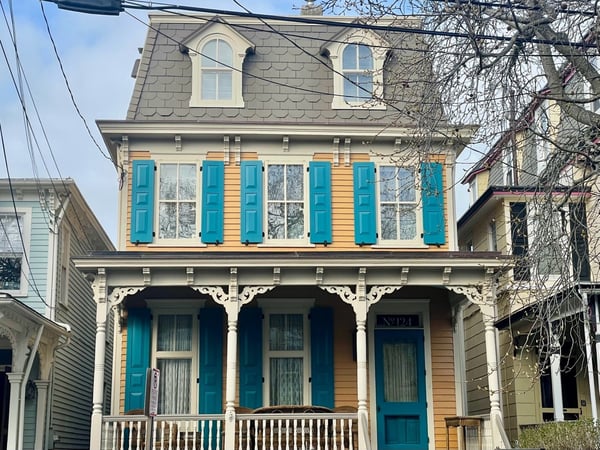
Named for Queen Victoria of England who reigned from 1837-1901, this period of architecture included several notable styles which are often referred to as “Victorian houses.” Between 1860 and 1900 Second Empire, Queen Anne, Shingle and Folk Victorian each have their own distinctive appearance, influenced by the rapid industrialization of America in the late 19th century.
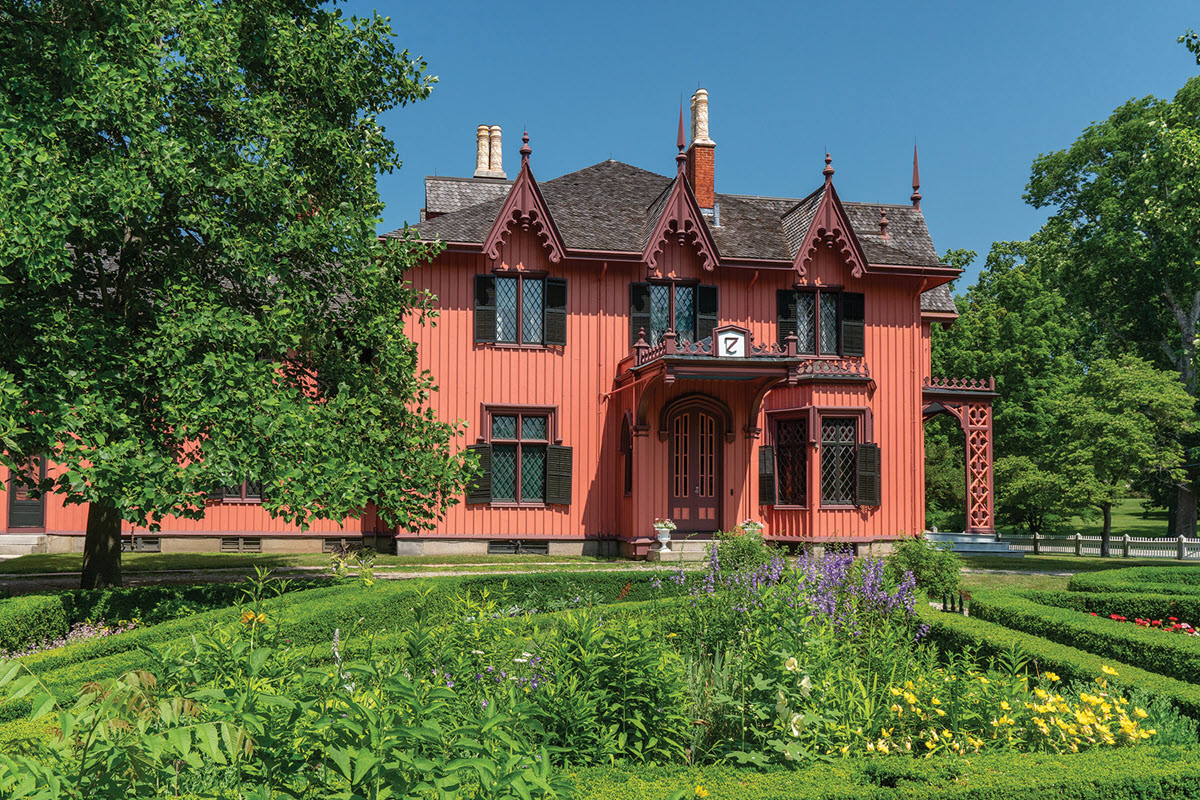
New architectural plan books with detailed construction drawings for craftsmen, and the illustrations featured in a widely read magazine titled AMERICAN ARCHITECTURE and BUILDING NEWS introduced new, ornamental styles, and building materials. New industrial woodworking machinery. The steam powered sawmill and planer augmented the hand-crafting of decorative elements. Stock moldings, mass produced and standardized were now available and more widely distributed via the ever-expanding railroads. “Gingerbread” thrived in this period! Multi-colored and multi-textured walls, steep-pitched roofs, and asymmetrical facades were loosely based on Medieval prototypes A new construction method, “balloon framing” began to replace heavy timber construction which made building irregular designs, like the round turret and asymmetrical roof massing of Queen Anne houses, more possible.
Handmade exterior shutters in the early 1800s would vary in size, detailing and joinery depending on the skill of a local craftsman and available materials. But during the industrial age, the shutter’s components, such as the slats that make up the louvers could be machine cut and were therefore more uniform. But even factory-made shutter-parts required the craftsman to assemble and finish the final product.
The Victorian era’s architectural exuberance made houses look busier than the Federal and Georgian styles of earlier periods, and more complex. This could explain why the styles of this period favored exterior shutters for their function rather than their decorative advantage. Nevertheless, there are many handsome and iconic houses in the Victorian period which are adorned by exterior shutters including Theodore Roosevelt’s Sagamore Hill on Long Island and the famous Shingle houses of architects McKim Mead and White in Newport Rhode Island.
SECOND EMPIRE 1855-1885
The mansard roof with dormers is the defining characteristic of Second Empire houses, as well as decorative brackets under the eaves, hooded windows, a double front door and often a cupola or a tower. Windows are usually tall, some both round-topped and with mutons.
The Second Empire house was in it’s heyday throughout the 1870s, and was built mostly in northeastern and midwestern cities. It imitated French building fashion; the roof got its name from the 17th century French architect François Mansart. This roof type allowed for living space in the top attic floor and was particularly well suited in scale and proportion, for townhouses.
Exterior shutters on Second Empire houses and in many cases civic buildings were often tall, rectangular or elliptical and louvered. There are some examples of shutters for the dormer windows on the mansard roof but more often these windows had a decorative hood over the top and a scroll at the base which was decoration enough without shutters!
QUEEN ANNE 1880-1910
For both their innovative shapes and their decorative detailing, the Queen Anne house is probably the most widely recognized architectural style of the Victorian period. Wrap-around front porches, steep-pitched gable and hipped roofs, stain-glass windows, round turrets with a cone-shaped roof and asymmetrical facades are all common characteristics of this eclectic house type. Queen Anne houses are also often multi-colored, to enhance their architectural detailing, hence the nickname “painted ladies,” or the Queen Annes of San Francisco. In California, these are often the grand houses of the lumber baron, the railroad magnate and the mining millionaire.
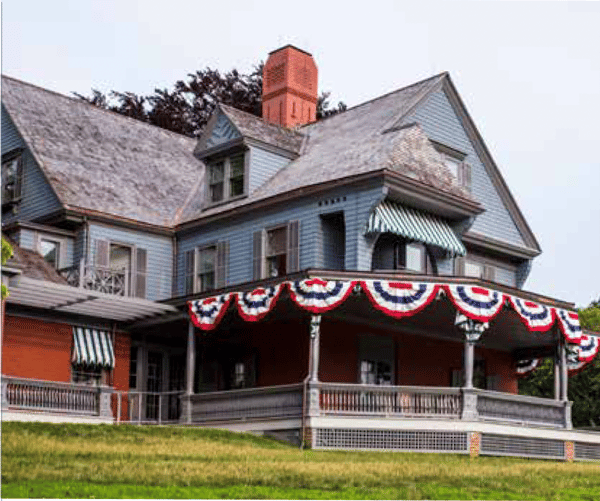
President Teddy Roosevelt’s Queen Anne house, Sagamore Hill in Long Island New York.
At least half of the Queen Anne houses built in the later 19th century have delicate turned porch supports and spindlework, ornament made by machine lathes. Porch support columns are often grouped in units of two or three. Decorative elements dominate the Queen Anne façade. Flat exterior wall surfaces gave way to bay windows, towers, overhangs and textured siding materials like scalloped-shingled siding. Like the Second Empire houses of this period, shutters competed with an abundance of other decorative exterior elements so that their important function, climate control and security, took on more importance.
Like most house- styles of this century, the look and shape of Queen Anne evolved. Chicago’s Columbian Exposition in 1893 popularized classical adaptations (again), which lasted well into the 1900s and influenced other styles of this period including the Shingle style.
SHINGLE STYLE 1880-1910
Unlike most of the other 19th century styles that precede it, the Shingle style does not emphasize decorative detailing at doors, windows, cornices, porches, or on wall surfaces. Instead, it aims for the effect of a complex shape enclosed within a smooth shingled surface.
Shingle style houses were popular for a short period and considered fashionable in upper echelon locations along the northeast coast in places like South Hampton Long Island and Newport Rhode Island. It is considered a unique adaptation of other American architectural traditions, a signature style of the famed architects McKim Mead and White.
It is likely that because of their homage to classical architecture, Shingle style houses, some but not all, had exterior shutters, and their coastal locations required it. A notable example of this is the Bell House 1883 in Newport designed by McKim Mead and white Architects.
FOLK VICTORIAN 1870-1910
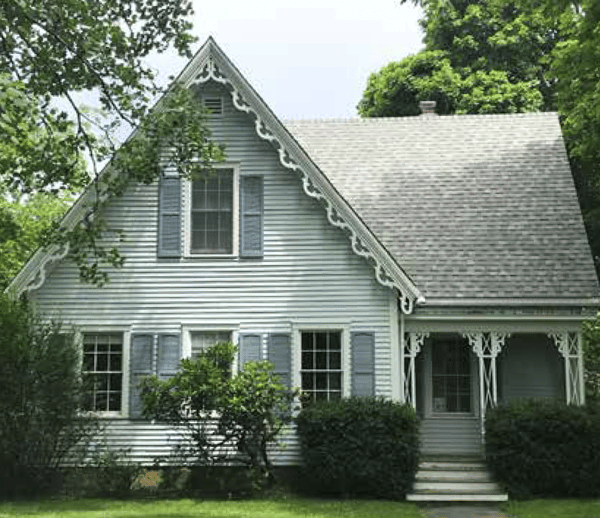
A Folk Victorian in Massachusetts
Like other house styles of the Victorian era, Folk Victorian houses are decked out with gingerbread detailing, especially on front porches and on the front façade gable. They differ from Queen Anne and Shingle style because their shapes return to simple symmetrical forms. Lace-like spandrels and turned balusters are used in porch railings and friezes suspended from the porch ceiling. Exterior surfaces are smooth unlike the textured exteriors of Queen Anne.
The wedding cake, wood decoration on Folk Victorian houses was made possible by woodworking machinery, shipped to lumberyards by railcars. These new industrial age woodworking machines could mass produce per-cut Victorian detailing, inexpensively. This millwork was a popular remodeling front-porch addition to simple cottages. New Orleans has one of the best collections of Folk Victorian houses called “the shotgun” house, a deep but narrow lot configured cottage with columns and spindlework on the small front porch.