Request a Catalog



EARLY CLASSICAL REVIVAL 1770-1830
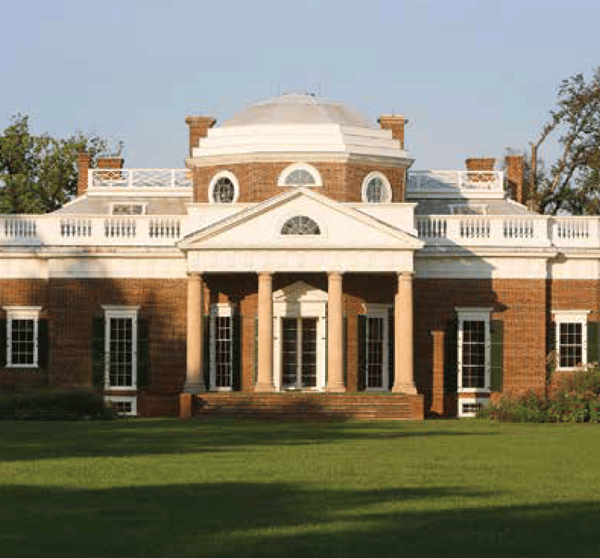
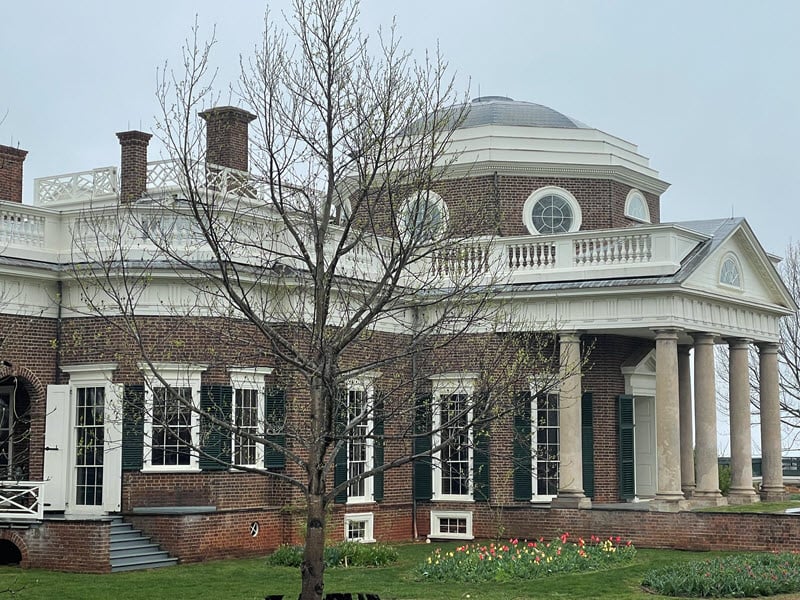
The Federal architecture of Alexander Hamilton gave way to early Classical Revival architecture with Thomas Jefferson. Jefferson was highly influenced by Andrea Palladio’s Four Books of Architecture. His own houses, Monticello, Polar Forest as well as his design for the University of Virginia led the way for the popularization of Classical Revival architecture, particularly in the south.
With Rome as its model, Classical architecture expressed our New Republic and reflected the mood and politics of our new country. With our new government came the need for new public buildings, both state and national buildings, which were designed in this new fashionable Classical Revival style.
Early Classical Revival architecture is characterized by a portico at the front entrance, often two stories high, supported by four columns, either Roman Doric or Tuscan. The columns support a prominent centered gable, a semi-circular fanlight over a paneled front door. There were between three and seven but usually five-ranked windows all equal size across the front façade. The roof is side-gabled or hipped. Except for Jefferson’s Monticello, the dome was more common on public buildings.
EARLY CLASSICAL REVIVAL SHUTTERS
Given the grand scale of most Classical Revival houses which have two story columns and tall windows, tall shutters are appropriate. And because Classical Revival is predominately a southern style, Virginia, the Carolinas, Georgia and Mississippi, shutters will likely be louvered to provide ventilation while closed for shade. Early Classical architecture is still long before air conditioning!
The Semple House in Williamsburg Virginia, attributed to Thomas Jefferson is a good example of the Classical Revival three-part plan. It has a center block two stories high, a center entrance door surrounded by the typical portico, flanked by tall windows which have proportionate tall louvered shutters. Upstairs on the second story façade, are three shorter symmetrical windows, each with a pair of louvered shutters, also shorter than the ones below.
EARLY CLASSICAL REVIVAL SHUTTER HARDWARE
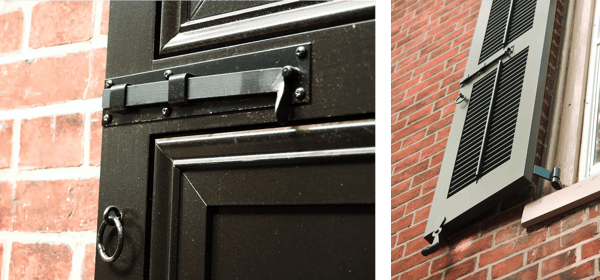
Like the louvered shutters on Federal houses, Early Classical shutter hardware is refined, even dainty but must be strong enough to operate tall shutters which are open and closed more often, due to their southern climate. In other words, this hardware must both look and BE functional. Black wrought iron is the most period- authentic.
The strap hinges are often tapered or spear- ended. They attach to metal pins called “pintels” which are screwed in the masonry or wood trim. For classical brick homes, common in the southern states, “butt hinges” are mortised into the shutter and window casing which are more discreet than strap hinges. “Lag pintels” have a threaded shaft hammered into the masonry. “Drive pintels” have a tapered shaft, also embedded into the masonry window surround.
“Tiebacks” hold the shutters against the wall. As with Georgian and Federal houses, the “S” scroll or “harp” are appropriate for Classical Revival shutters. These tiebacks pivot on the mounting bolt and rest over the shutter to hold it open. But since these warm weather climate shutters keep the house cool when closed, the fasteners, either slide bolts (top and bottom on the interior edge), storm bars or interior bars look historically appropriate and are operable.