Request a Catalog



The Romantic Houses 1820-1880: Greek Revival, Gothic Revival and Italianate
In the years following the War of 1812 America established its own architectural identity. Georgian architecture dominated the English colonies in the early 18th century then gave way to Greek Revival which expressed our democratic ideals in America’s New Republic.
Greek Revival architecture is characterized by a low-pitched gable or hipped roof with a cornice line of main roof and front porch roof, emphasized with a wide band of trim, usually divided into two parts, the frieze above and architrave below. Porches are often two stories supported by Doric columns. The front door is elaborate with side lights and transom windows above.
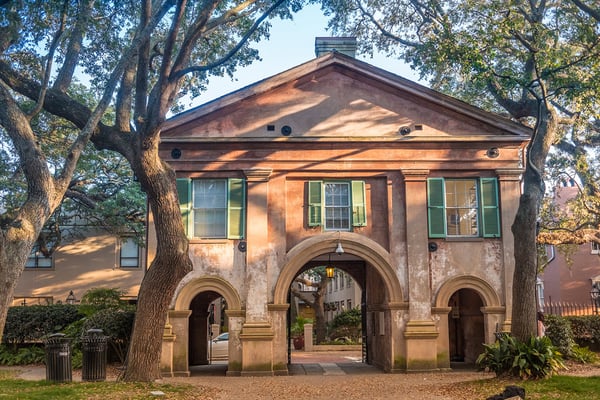
A Greek Revival in Charleston SC
The proportion and scale of the Greek Revival two story house with tall two-story columns accommodate similarly scaled tall exterior shutters, usually but not always louvered. Where the columned front porch is one story, surrounding the front door and not extending the width of the house, the most common Greek Revival houses will have two windows on a horizontal line with the door on the first story and three symmetrical windows up above on the second story. Unlike Federal where windows and their shutters upstairs might be smaller than those below, Greek Revival windows and shutters will all be the same size.
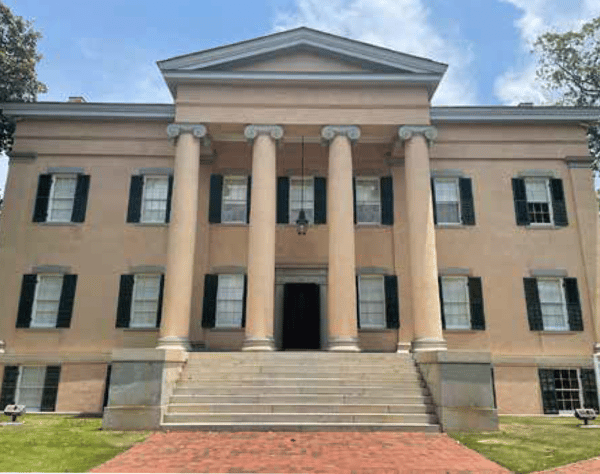
A Greek Revival mansion with Shutters on Every window!
But there are several window and shutter variations on the Greek Revival house depending on whether it’s a grand manse or an urban townhouse. Some handsome examples of Greek Revival architecture with tall louvered shutters include the Clarke-Ford House in Chicago (1827), the Old Governor’s mansion in Georgia (1839) and the Neil Cohcoran House (1855) in Texas. One distinction of these tall louvered shutters is that they feature three panels These tall louvered shutters have three equal size panels with a horizontal rail between each. These panels not only look good by breaking the long plane into symmetrical parts, but the rails make a tall shutter sturdier.
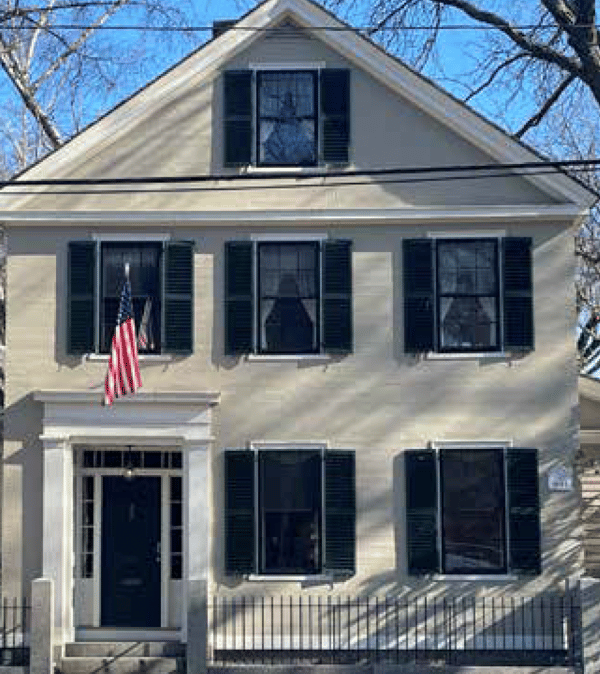
A Greek Revival with Uniform Shutters on both stories
The craftspeople in the Timberlane shop delight in making tall, custom, sized-to-fit louvered Greek Revival shutters, with either fixed or operable louvered slats. At their beginning thirty years ago Timberlane’s building artisans would have made these shutters with mahogany, the world’s most beautiful and sustainable wood species. This would replicate the shutters of 1825-1860, but back then only locally available woods were used such as Atlantic white cedar in New England or cypress in the South. Nowadays, these same craftsmen use mahogany, each piece hand-picked, or Timberlane’s exclusive PVC Endurian which combines historical accuracy with low maintenance. Timberlane’s 24 color options come from Benjamin Moore’s selection of authentic historic colors with historic names like Palladian Blue Van Burean Brown and Gettysburg Grey.
Gothic Revival
In 1842, the first of the popular pattern books illustrating full-façade drawings of house styles was published by Andrew Jackson Downing. This pattern book, titled COTTAGE RESIDENCES showed alternatives to the ubiquitous Greek Revival houses of the day, and provided self-taught architects, builders and homeowners with new design ideas.
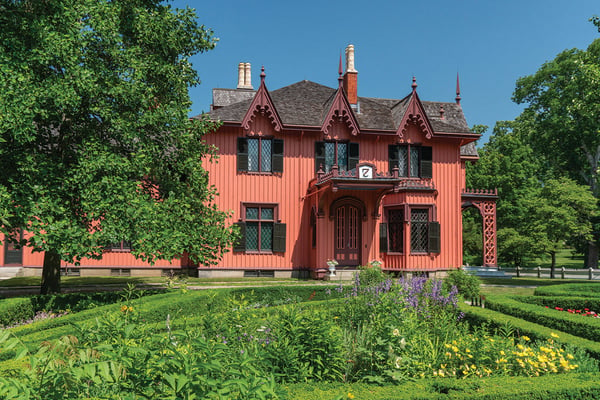
Drawing from Medieval precedent, the Gothic Revival style became popular starting in 1840. Country, Gothic houses have steep pitched roofs, with side gables with decorative trusses, windows with pointed arches and diamond shaped panes, full length window-shutters from the front porch floor to just below the ceiling. Porches are supported by tall thin columns topped with a decorative entablature.
Unlike prior classical architecture, the Gothic style reveled in asymmetrical forms! Houses were made of stone or wood, the latter evolving from Gothic Revival to Stick Style or Carpenter Gothic. The shutters on these ornate houses were often tall; flanking windows almost floor to ceiling on the first floor but shorter on smaller windows upstairs. This Gothic style frequently featured a wider variety of shutter-shapes like arch-top shutters which close over Gothic arch-top windows or radius top shutters in keeping with the novel charm of asymmetry.
Over their thirty-year history Timberlane’s ability to make custom shapes and sizes evolved with the demand for historical shutter replication, an evolution not unlike that which occurred when 19th century builders, designers and homeowners saw what was available in the new pattern books of their day.
Italianate
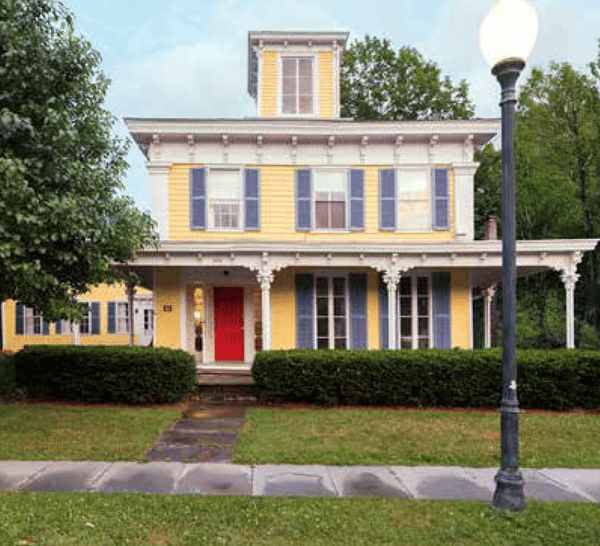
Italianate 1840-1885 continued the trend to more exterior architectural ornament in the Romantic House period. Italianate houses are almost always two or three stories with a low-pitched roof, over-hanging eaves with decorative brackets beneath, tall narrow windows, often arched or curved at the top. One of the most defining features of Italianate houses is the square cupola or tower, not unlike villas of the Italian countryside.
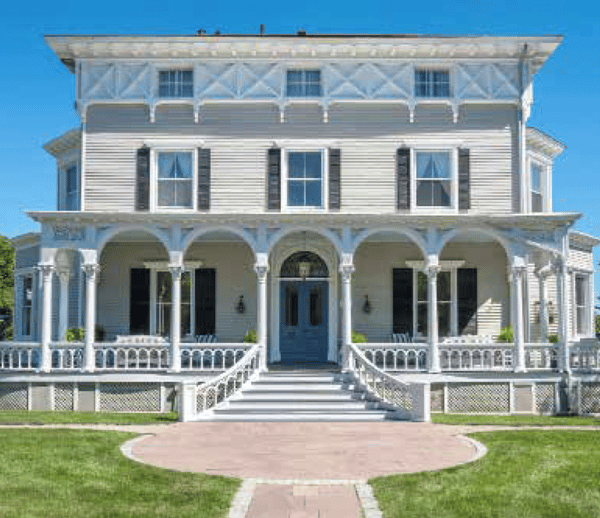
A Remodeled but Historic Italianate with “Romantic Flourishes”
Italianate windows have one or two panes glazing and are commonly topped with an arch, a crown or a curve if not a rectangle. Paired and triple windows are frequent as are one- and two-story bay windows. Here again exterior shutters are tall, in proportion to the tall windows they adorn. Italianate houses in the Midwest are less likely to have shutters than those in warm and coastal areas, like this iconic house in Cape May N.J. on the Atlantic Ocean or this house in Salisbury N.C. Note the arch-top shutters on the bay window and radius top louvered shutters flanking tall thin windows on the first and second stories.
Throughout the 1800s long before air conditioning, both porches and louvered shutters were important for keeping cool in the sun and dry in the rain, especially in warm and coastal climates. Exterior shutters continue to play their functional and decorative role in American architecture of the Romantic-house period 1825-1860.